Roy Church
In Cold BloodRoy Church is a veteran investigator in the Kansas Bureau of Investigation whose work links two different phases of the Clutter case: the uncertain search for a motive in Kansas and the confrontation of Dick after his arrest in Las Vegas. His early inquiry produces a plausible but unconfirmed grudge lead; later, working with Harold Nye, he helps bring the evidence against Dick into the interrogation room and states the formal charges that prompt Dick to blame Perry Smith.
Identity and Place in the Investigation
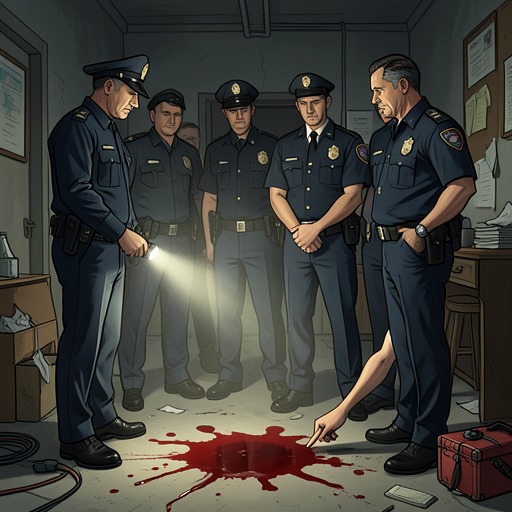
Church is about sixty, pink-skinned, and professorial in appearance. His colleagues nevertheless describe him as tough and as the fastest draw in Kansas. They call him Curly because he is partly bald. The contrast between the mild academic impression and the reputation for toughness gives him a distinct place in the investigative team: he appears unshowy, but is regarded by fellow agents as capable and formidable.
The Kansas Bureau of Investigation sends Church to Garden City as one of three experienced agents assigned to assist Alvin Adams Dewey, alongside Harold Nye and Clarence Duntz. By the later stages of the case, eighteen men are working on it full time. Dewey considers the arriving trio a strong team, and Church’s work belongs to a larger effort that has become a major public story, drawing journalists and investigators from outside the community.
The Early Grudge Lead
During the initial inquiries, Church hears of a man identified as Mr. Smith, whose name is explicitly not his real one. The man reportedly resented Herbert Clutter because he believed Clutter had shot and killed his hunting dog. Church follows the lead to the man’s farm home and inspects it. There, he notices a rope hanging from a barn rafter, tied with the same kind of knot used to bind the four Clutters.
The resemblance makes the lead more concrete than a bare report of hostility: it joins a possible personal grievance to a physical detail associated with the crime. Yet the evidence presented at this stage establishes a lead, not the man’s responsibility. Set beside another grudge theory and the continuing debate over robbery as a motive, Church’s discovery shows how investigators must test circumstantial correspondences without mistaking them for a solution. The investigation is not yet able to distinguish a meaningful connection from a coincidence.
The Las Vegas Interrogation
After Dick and Perry are arrested, Church travels with the Kansas investigators to Las Vegas. Nye has arrived earlier by plane; Church, Dewey, and Duntz make the journey by car and are delayed by bad weather, spending New Year’s Eve snowed in at a motel in Albuquerque. The trip ends with practical developments that strengthen the case: Dick and Perry have signed extradition waivers, and the investigators have recovered both pairs of boots. Their soles match life-size photographs of footprints found in the Clutter house.
The team divides its interrogation work. Nye and Church are assigned to question Dick, while Dewey and Duntz handle Perry. The arrangement makes Church part of the effort to test Dick’s account against physical evidence, not simply a witness to the investigators’ conclusions. At their first meeting, Nye describes Dick as thinner and younger-looking than expected, polite in manner, and initially prone to smiling. Those impressions form the setting for an interview in which the agents must press a suspect who does not at first present as an obvious threat.
When the interview turns to evidence, Nye displays a one-to-one reproduction of footprints found near Herbert Clutter’s body and identifies the boots that made them as Dick’s. He also states that Perry’s boots fit another set of prints, including bloody ones. Church then spells out what Dick faces: a return to Kansas and four counts of first-degree murder, with the charges identifying Herbert Clutter and the other members of the family as victims. The formal recital converts the boot evidence into an immediate legal consequence and forces the conversation away from general denials.
Accusation and Narrative Function
Dick responds by saying that Perry killed the Clutters and that he could not stop him. The sequence gives Church a sharply defined role in the confession narrative: Nye presents the forensic comparison, and Church states the charges; Dick’s accusation follows. The scene does not establish that Church independently proves Dick’s account, but it shows how the confrontation narrows the space in which Dick can answer without addressing the murders directly.
Church’s part in the case also illustrates the difference between an investigative lead and evidence brought to bear on a suspect. His early rope observation adds a suggestive resemblance to an unverified grudge theory. In Las Vegas, the investigators instead possess boots matched to photographed footprints and use that evidence during a formal interrogation. Church appears at both points in the chain: first as a field investigator noticing a possible clue, then as an agent articulating the charges. His relatively limited but consequential appearances make him one of the agents through whom the book shows investigation as a process of collecting, evaluating, and confronting evidence rather than arriving at certainty all at once.